
Why Most Men Get Recovery Wrong
When training stops delivering results after 40, most men assume the problem is the workout.
They look at the program.
They look at the exercises.
They look at the intensity.
Almost no one looks at recovery first.
Recovery is usually treated as something that just happens in the background, a passive byproduct of training hard enough. If progress slows, the instinct is to add more: another set, another session, another push.
That logic works when recovery is abundant.
After 40, it often isn’t.
What makes this frustrating is that the effort is still there. You’re still showing up. You’re still pushing yourself. But instead of feeling stronger, you feel tired. Instead of building momentum, you feel like you’re constantly trying to get back to baseline.
So the natural conclusion becomes:
“I need to train harder.”
In reality, the problem is often the opposite.
Recovery isn’t optional after 40. It’s not something that happens automatically. It’s the condition that allows training to work at all.
When recovery is overlooked, even well-designed workouts start to underperform. Not because the exercises are wrong, but because the body never fully adapts between sessions.
This is where many men get stuck.
They keep adjusting the workout.
They rarely adjust the recovery.
Training Is the Stimulus – Recovery Is the Adaptation
Training does not build muscle.
Training does not increase strength.
Training creates a stimulus.
That distinction matters more after the age of 40 than it ever did before.
When you lift, press, pull, or squat, you are applying stress to the body. That stress disrupts homeostasis. It creates fatigue. It creates microscopic damage. It signals that something needs to change.
But the change, the adaptation, does not happen during the workout.
It happens afterward.
It happens when the body has enough time, nutrition, and energy to repair and rebuild. It happens during sleep. It happens between sessions. It happens when stress is low enough that recovery systems can actually do their job.
In other words:
Training is the signal.
Recovery is the response.
This is what that cycle actually looks like:
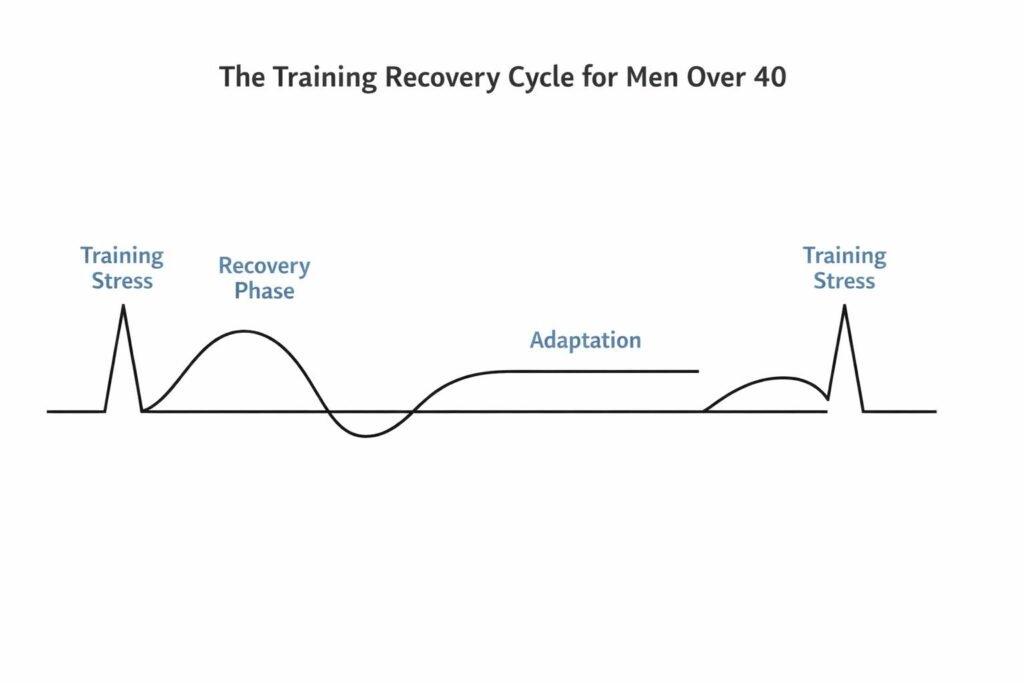
This is the same principle discussed in the broader framework of Training After 40, the relationship between stress and recovery determines progress. After 40, that relationship becomes less forgiving.
When recovery is adequate, the body adapts upward.
When recovery is insufficient, the body simply absorbs stress without improving.
That’s where many men get confused.
They feel exhausted after a hard session and assume progress is happening because the effort was high. But fatigue and adaptation are not the same thing. You can be tired without getting stronger.
After 40, the margin between stimulus and overload narrows. The same workout that once created growth can now create only fatigue if recovery does not match it.
This is why recovery is not secondary to training.
It is the mechanism that makes training work at all.
What Recovery Actually Includes After 40
When most people hear “recovery,” they think of rest days.
In reality, recovery is broader than that, especially after 40.
It starts with sleep.
Sleep is where the majority of repair and hormonal regulation takes place. It’s where training stress is processed. When sleep is shortened or fragmented, recovery capacity drops quickly. You may still be able to complete your workouts, but the quality of adaptation declines.
After 40, poor sleep is no longer a minor inconvenience. It becomes a limiting factor.
Nutrition plays a similar role.
Recovery requires raw materials. Protein supports tissue repair. Adequate calories prevent the body from treating training as a threat rather than a stimulus. Hydration affects performance and joint comfort more than most people realize.
In younger years, the body can compensate for inconsistent eating. After 40, those margins shrink. Training hard while under-fueled often results in accumulated fatigue rather than progress.
Time between hard sessions is another overlooked variable.
Muscle may feel ready within a day or two. Connective tissue and the nervous system often require longer. When intense sessions are stacked too closely together, recovery never fully completes before the next stress cycle begins.
That’s when progress flattens.
There’s also nervous system fatigue, the less visible side of recovery.
Heavy lifting, high effort, and emotional stress all draw from the same system. You may not feel sore, but you feel flat. Motivation drops. Weights feel heavier than they should. Small tasks require more effort.
That’s not a weakness. It’s accumulated fatigue.
Recovery after 40 is not just about taking days off.
It’s about recognizing that sleep, nutrition, spacing of sessions, and overall stress load all interact. When one is compromised, the others have to work harder to compensate.
If recovery is incomplete, training quality declines, even if discipline remains high.
What Happens When Recovery Is Ignored
When recovery is consistently overlooked, the effects rarely show up immediately.
They accumulate.
At first, it feels like normal training fatigue. You’re a little more tired than usual. Workouts feel slightly harder. You assume it’s just part of pushing yourself.
But when stress continues without full recovery, fatigue compounds.
Performance becomes inconsistent. Some days feel fine. Others feel inexplicably heavy. Weights that were manageable a few weeks ago suddenly feel demanding.
Because the change is gradual, it’s easy to misinterpret.
Many men assume the problem is motivation.
They think they’ve lost their edge.
They believe they need to “get serious” again.
They question their discipline.
In reality, what often looks like a mindset issue is accumulated fatigue.
The body isn’t unwilling.
It’s under-recovered.
As fatigue builds, small warning signs appear:
- Strength stops progressing
- Joints feel stiffer
- Warm-ups take longer
- Sessions feel harder than they should
Instead of improving, training starts to feel like maintenance, or even regression.
The common response is to increase effort. Train harder. Add volume. Push through.
But adding more stress to an already under-recovered system doesn’t create progress. It deepens the deficit.
That’s why some men find themselves working harder than ever while feeling worse than before.
It isn’t that training stopped working.
It’s that recovery never fully caught up.
Without adequate recovery, the body prioritizes protection over adaptation. It conserves energy. It limits output. It resists further stress.
This isn’t a failure of willpower.
It’s physiology doing its job.
What Prioritizing Recovery Changes
When recovery is given the same importance as training, the change is rarely dramatic.
It’s steadier than that.
The first difference most men notice is consistency.
Workouts stop feeling unpredictable. Good sessions become more frequent. Strength begins to move forward again — not in sudden jumps, but in small, repeatable steps.
Instead of cycling between progress and setbacks, training starts to feel stable.
Flare-ups become less common.
Joints feel more cooperative. Warm-ups feel smoother. Minor aches no longer escalate into something that forces time off. The body feels like it’s keeping up, rather than falling behind.
Performance per session improves as well.
When recovery is adequate, you don’t need extended warm-ups just to feel normal. You don’t spend half the workout trying to wake up. You arrive with energy, apply focused effort, and leave without feeling drained for the rest of the day.
The quality of each session increases — even if the total workload decreases slightly.
There’s also a mental shift.
When recovery is respected, training stops feeling like something you have to push yourself into. The quiet resistance that builds after weeks of accumulated fatigue fades. You don’t need to manufacture motivation. You feel ready to train.
That readiness is often mistaken for enthusiasm or discipline.
In reality, it’s the absence of chronic fatigue.
Prioritizing recovery doesn’t make training easier in the moment. Hard sets are still hard. Effort still matters.
What changes is what happens afterward.
Instead of barely recovering in time for the next session, you complete the cycle. Stress is applied. Adaptation occurs. You return stronger, not just more tired.
Over time, that steady pattern builds more strength than repeated bursts of intensity ever could.
Recovery Is Not Passive
Recovery is often described as rest.
But after 40, recovery isn’t passive. It’s deliberate.
It’s the decision to stop a set when the quality drops instead of chasing exhaustion.
It’s the choice to end a session knowing you can return strong in two days.
It’s protecting sleep the same way you protect training time.
It’s recognizing when fatigue is accumulating and adjusting before it becomes a setback.
None of that feels dramatic.
In fact, it can feel understated.
But it’s active.
Recovery is not what happens when you do nothing.
It’s what happens when you respect the limits that make progress possible.
Training provides the signal.
Recovery determines whether that signal becomes strength.
When recovery is treated as part of training — not something separate from it — the entire process becomes more sustainable. Sessions feel purposeful. Progress feels repeatable. Setbacks become less common.
This is what allows men to keep training year after year.
Not by pushing harder every time.
Not by squeezing more work into already full weeks.
But by applying stress intelligently — and giving the body enough space to respond.
Longevity isn’t built through intensity alone.
It’s built through complete cycles of stress and recovery, repeated consistently over time.
That’s what makes strength something you can keep.