Training After 40: How to Build Strength Without Breaking Yourself
At some point after 40, training stops feeling predictable.
You’re still showing up.
You’re still putting in effort.
But progress slows, recovery drags, and small aches start hanging around longer than they used to.
What’s confusing is that nothing dramatic has changed.
You’re not suddenly lazy.
You didn’t forget how to train.
And you are still eating healthy…relatively.
Yet the same workouts that once worked reliably now feel harder to recover from — and pushing harder often makes things worse, not better.
This is where a lot of men get stuck.
Some decide they just need more discipline and start pushing themselves harder.
Others assume decline is inevitable and slowly stop training altogether.
Both reactions miss what’s actually happening.
The issue isn’t motivation or toughness.
It’s that the cost of training changes as you age — and most advice never adjusts for that.
This article isn’t about giving up intensity or lowering standards.
It’s about understanding how training stress, recovery, and strength interact after 40 — so you can keep building strength without breaking yourself in the process.
If you are new to Old Guys Fit and me, then Start Here.
The Problem Most Men Run Into After 40
For a long time, training feels simple.
You show up, work hard, feel pumped, recover, repeat.
If progress slows, you push a little more — one extra rep, one extra set.
Still no progress? You add a couple of extra exercises to an already packed workout.
That approach works — until it doesn’t.
Somewhere after 40, the feedback loop changes.
Workouts that once felt productive start leaving you drained.
Motivation drops. Staying home suddenly feels more appealing than training.
Soreness lingers longer than expected.
Minor aches show up where there were none before — shoulders, elbows, knees, lower back.
You wake up in the middle of the night, shifting positions just to ease the pain in a sore elbow.
At first, it’s easy to brush off.
You assume it’s just a bad week.
Or poor sleep.
Or stress.
So you do what you’ve always done: train harder, add volume, chase the feeling that used to signal progress.
That’s where things start to go wrong.
Instead of better results, recovery gets worse.
That shoulder pain starts to feel chronic.
Instead of feeling stronger, you feel beat up.
Instead of momentum, you get inconsistency.
What makes this especially frustrating is that effort is not the problem.
You’re still disciplined.
You still care.
You’re not skipping workouts or looking for shortcuts.
You still feel guilty if you miss a week or two in the gym.
Yet progress stalls — or worse, small issues turn into injuries that force time off entirely.
This is the moment where a lot of men make one of two decisions.
Some decide they need even more discipline and intensity.
Others decide their best training years are behind them — and quietly retire from the gym altogether.
Both responses are understandable.
Both are based on the same false assumption.
That assumption is that the rules of training haven’t changed.
They have.
Why Training Has to Change (Physiology, Not Motivation)
When progress slows after 40, it’s tempting to assume something is wrong with your mindset.
Maybe you’re not as hungry as you used to be.
Maybe you’re not pushing hard enough.
Maybe you’ve lost your edge.
That interpretation is understandable — but it’s wrong.
What’s changing isn’t motivation.
It’s how your body responds to stress.
As you age, your recovery capacity gradually declines. Not dramatically, not overnight — but enough that the same training stimulus now carries a higher cost than it used to.
Workouts don’t just make you tired.
They create a recovery debt that has to be paid back through sleep, nutrition, and time.
After 40, getting recovery right matters more — and nutrition becomes less forgiving.
Your body can’t pull usable energy out of poor food choices the way it once could.
In your 20s and 30s, that recovery debt was easy to clear.
You could stack hard sessions back-to-back and still feel fine.
You could train on little sleep, go out late, and still be back in the gym the next day — sometimes repeating that cycle for days.
After 40, the margin for error narrows.
One of the key reasons for this is a process known as anabolic resistance — the age-related reduction in how efficiently your body responds to training and protein intake.
Put simply, your muscles don’t get the same signal from the same input anymore.
You can still build and maintain strength.
But the stimulus has to be more precise, and recovery has to be respected.
This isn’t a sign that your body is broken or fragile.
It’s a sign that it’s less forgiving than it used to be.
Ignoring that shift doesn’t make you tougher — it just increases the likelihood of stalled progress or injury.
The rules haven’t disappeared.
They’ve become stricter.
Training still works after 40.
But it only works when stress and recovery are balanced intelligently.
That balance — not effort — is what determines progress now.
Training Stress vs Recovery Capacity
Every workout creates stress.
That stress can be physical — muscle damage, joint load, nervous system fatigue — or systemic, like poor sleep, travel, work pressure, or low calorie intake.
None of that is inherently bad.
Stress is how adaptation happens.
The problem starts when stress exceeds your ability to recover from it.
This is the part most training advice skips.
Training only works if the stress you apply can be absorbed, repaired, and adapted to before the next hard session. That process depends on sleep, nutrition, hormones, and time — all of which become more limited as you get older.
After 40, recovery becomes the bottleneck, not effort.
This is what’s actually happening.
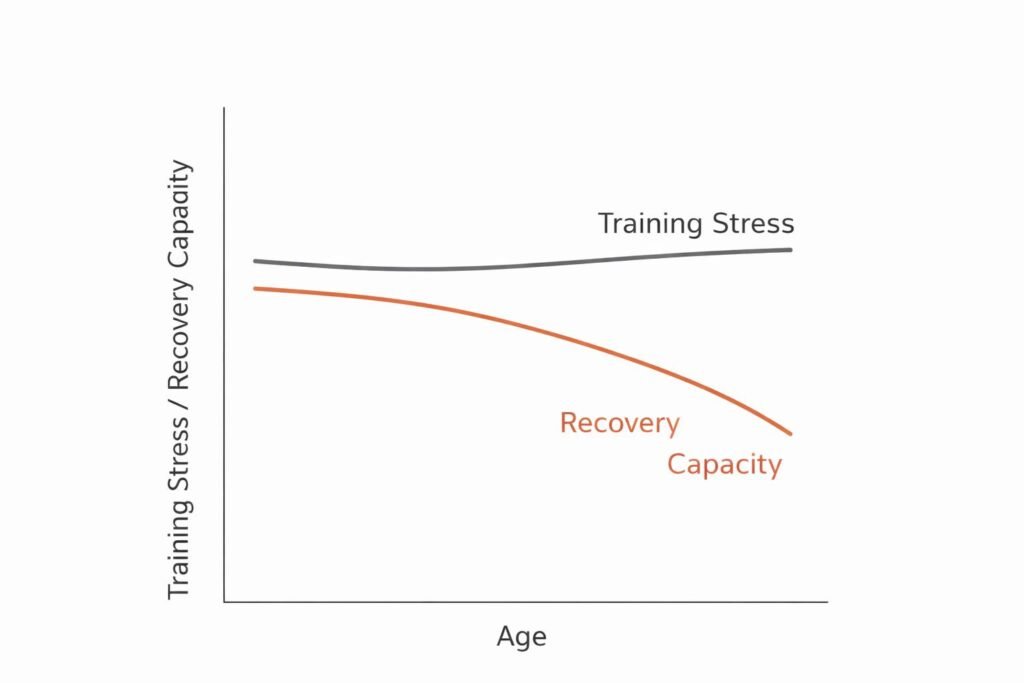
On one side, you have training stress — how hard, how often, and how much you train.
On the other hand, you have recovery capacity — how well your body can absorb that stress and turn it into progress.
When stress stays within recovery capacity, strength improves.
When stress consistently exceeds recovery capacity, progress stalls — or injuries appear.
In your 20s and 30s, that gap was forgiving.
You could push hard, stack sessions, recover “well enough,” and still move forward.
After 40, that margin shrinks.
The stress curve doesn’t need to increase much before it starts outpacing recovery. What used to be productive volume quietly becomes excessive. What used to feel like “good fatigue” starts turning into lingering soreness, poor sleep, and joint pain.
This is why doing more often produces less after 40.
It’s not that training stopped working.
It’s that recovery stopped keeping up.
If you exceed your recovery capacity once in a while, nothing bad happens.
But when you do it repeatedly — week after week — the body stops adapting and starts protecting itself.
That protection shows up as:
-
Persistent soreness
-
Declining motivation
-
Stalled strength
-
Nagging joint issues
-
Or forced time off entirely
Understanding this relationship changes how you train.
The goal is no longer to apply the maximum possible stress.
The goal is to apply the maximum recoverable stress.
That’s the difference between training that builds strength — and training that slowly breaks you down.
Volume, Intensity, and Why “More” Stops Working
Once you understand that recovery is the limiting factor after 40, the next question becomes practical:
What actually needs to change in training?
For most men, the answer isn’t intensity.
Its volume.
Volume — the total amount of work you do — is what accumulates fatigue the fastest. Extra sets, extra exercises, and extra sessions all add stress that has to be recovered from.
When you’re younger, you can get away with a lot of it.
After 40, volume is usually the first thing that quietly pushes you past your recovery capacity.
This is where a lot of well-intentioned training goes wrong.
Progress slows, so more is added.
Another set. Another movement. Another day.
The problem is that those additions rarely increase the quality of the stimulus — they mostly increase fatigue.
Intensity, on the other hand, is different.
Intensity is useful.
It’s what tells the body that strength matters.
But it’s also costly.
Heavy or near-limit work places higher demands on the nervous system and connective tissue. That doesn’t mean it should be avoided — it means it should be used deliberately.
After 40, the goal isn’t to eliminate intensity.
It’s to support it by removing excess volume.
This is why older lifters tend to do better with:
-
Fewer working sets
-
Better execution
-
Clear intent in each session
What stops working is junk volume — work that adds fatigue without adding a meaningful training signal.
More sets don’t automatically mean more progress.
They often just mean more recovery debt.
Quality becomes the differentiator.
A small number of hard, well-executed sets — performed while you’re fresh enough to recover — will do more for strength than long, grinding sessions that leave you depleted for days.
This is the shift most men struggle to make.
They equate effort with duration.
They equate soreness with effectiveness.
They equate doing more with trying harder.
After 40, those assumptions stop paying off.
Progress comes from applying just enough stress to stimulate adaptation — and no more than you can recover from consistently.
Fewer hard sets.
Better execution.
More respect for recovery.
That’s not lowering standards.
That’s training with precision.
Joints, Tendons, and the Cost of Repeated Stress
One of the biggest differences in training after 40 isn’t how muscles respond — it’s how connective tissue does.
Muscle adapts relatively quickly.
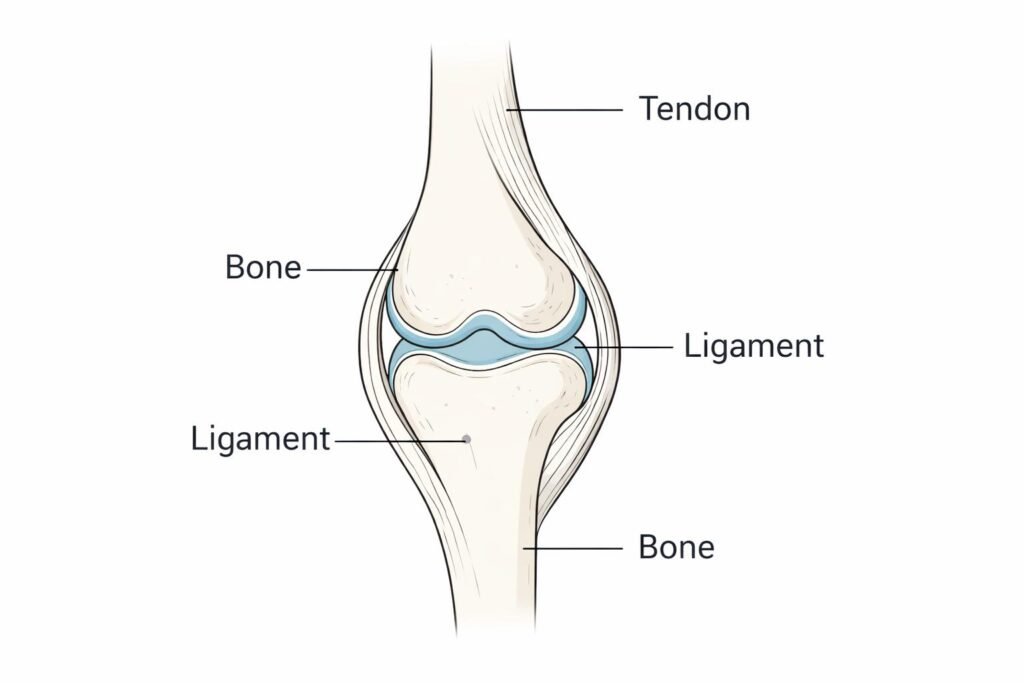
Tendons, ligaments, and joint structures do not.
They remodel more slowly, recover more slowly, and tolerate repeated stress less forgivingly over time. When training volume and intensity are managed well, this isn’t a problem. When they aren’t, small issues start to accumulate.
This is where many men get caught off guard.
A bit of elbow discomfort.
A shoulder that feels “tight” but still works.
A knee that needs more warming up than it used to.
At first, none of this feels serious.
You train through it.
You adjust slightly.
You tell yourself it’ll settle down.
And often, it does — temporarily.
That’s what makes connective tissue issues tricky.
They rarely stop you immediately.
They just start charging interest.
Every session that slightly exceeds your ability to recover adds to a growing recovery debt. Individually, those sessions don’t look like a problem. Over weeks and months, they compound.
Ignoring those signals works — until it doesn’t.
When connective tissue finally pushes back, it tends to do so abruptly. What felt manageable becomes persistent. What felt like stiffness becomes pain. What felt like something you could “train around” suddenly forces time off.
This isn’t because the tissue is weak.
It’s because it’s been asked to tolerate more stress than it can adapt to.
Longevity in training isn’t about avoiding discomfort or being overly cautious.
It’s about recognizing that muscles aren’t the only limiting factor anymore.
Strength after 40 is built by respecting the tissues that make strength possible.
That means:
-
Allowing enough recovery between hard sessions
-
Reducing unnecessary volume
-
Paying attention to recurring signals instead of overriding them
When joints and tendons are given time to adapt, they remain resilient.
When they’re treated like muscle — pushed hard, often, and without margin — they eventually become the bottleneck.
Training that lasts isn’t just about what you lift.
It’s about what your body can tolerate repeatedly, year after year.
What Smart Training After 40 Actually Looks Like
Once training stress and recovery are understood, the goal becomes much simpler.
Smart training after 40 isn’t about doing less.
It’s about doing what you can recover from — consistently.
That shift alone removes a lot of pressure.
Hard training still has a place.
It just doesn’t need to happen as often.
Most men do better when hard sessions are separated by enough recovery to actually benefit from them. That might mean fewer intense days per week, or more variation in how hard each session truly is.
Another important change is learning to leave reps in reserve more often.
Training close to failure has its place, but it carries a high recovery cost. After 40, staying one or two reps away from failure on most sets allows you to train hard without constantly accumulating fatigue.
Progress comes from repeated quality sessions — not from how exhausted you feel when you leave the gym.
Recovery also stops being something that “just happens” in the background.
Sleep, nutrition, and downtime between sessions become active parts of training. When recovery is prioritized, performance improves. When it’s ignored, training quality quietly declines.
This is why consistency matters more than heroic effort.
Big, aggressive pushes might feel productive in the moment, but they’re difficult to sustain. Training that you can repeat week after week — without nagging pain or mental burnout — is what builds lasting strength.
Finally, smart training requires regular adjustment.
Not day to day.
Not based on mood.
But week to week, based on how you’re actually recovering.
If something feels harder than it should, that’s information — not a failure. Small adjustments made early prevent bigger setbacks later.
This approach isn’t cautious.
It’s precise.
It allows you to keep training hard, stay healthy, and continue building strength — without constantly feeling like you’re one bad workout away from a setback.
The Real Goal: Strength You Can Keep
For a long time, progress in training is measured by speed.
More weight.
More reps.
More visible change.
That way of thinking makes sense early on. When recovery is fast and setbacks are rare, pushing for quick gains feels harmless.
After 40, that scoreboard starts to work against you.
Getting stronger fast often comes at the expense of staying strong long.
Short bursts of progress are followed by layoffs, flare-ups, or forced resets that erase the gains you worked for.
This is where the definition of progress needs to change.
Staying strong — year after year — matters more than chasing short-term peaks.
Injury-free months and years matter more than personal records that come with a cost.
That doesn’t mean ambition disappears.
It means ambition becomes patient.
Strength that you can keep shows up as capability.
Being able to train consistently.
Being able to move well on days you don’t train.
Being able to handle physical tasks outside the gym without hesitation.
Aesthetics may change over time.
Capability compounds.
When training is aligned with recovery, joints stay healthy, and effort is applied intelligently, strength becomes something that supports your life instead of competing with it.
Training shouldn’t dominate your schedule, your energy, or your identity.
It should make everything else easier.
That’s the shift that allows men to keep training into their 50s, 60s, and beyond — not by fighting age, but by working with it.
The Long Game
Training after 40 isn’t about fighting age or trying to prove something.
It’s about understanding how your body actually works now — and adjusting accordingly.
Strength doesn’t disappear because you get older.
It disappears when training ignores recovery, when effort stays high, but precision disappears, and when setbacks are treated as failures instead of signals.
Smart adjustment beats stubborn effort.
When stress is applied carefully, recovery is respected, and volume is kept within what you can sustain, strength becomes something you can build and keep — not something you chase until it breaks.
This is how men continue training into their 50s, 60s, and beyond.
Not by clinging to old rules.
Not by pretending nothing has changed.
But by working with the body they have now.
That approach doesn’t lower standards.
It raises the likelihood that training stays part of life for the long run.
And that’s the real win.
Learn more about why this site exists